


The start of the Murmellius
1513
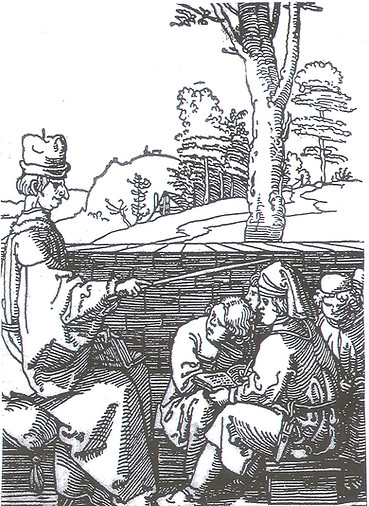
Johannes Murmellius was a Dutch humanist, pedagogue, and Neo-Latin poet. He was born in Roermond and studied in Deventer and Cologne, where he became a Master in 1504. He taught in Münster (1500–1513), Alkmaar (1513–1517), and Deventer (1517). Murmellius viewed the reform of education in a humanist sense as his life's mission. Murmellius wrote educational treatises and textbooks that were enormously successful and were used in Dutch, German, French, Italian, and Polish schools until the end of the eighteenth century.
In 1513, the city council of Alkmaar managed to bring the capable pedagogue-humanist to Alkmaar. Murmellius became rector of the Alkmaar school. Many of his pupils followed him to Alkmaar. Under Murmellius, the number of pupils rose to over 900, whereas in normal times it would have been at most 150. Murmellius was evidently pleased with this as well, as is apparent from an epigram he composed in 1514, which begins as follows:
"Quam bene gymnasium tradendis artibus aptum excelso positum est Alcmariense loco (...)"
(How excellent it is, that the Alkmaar gymnasium, suitable for learning the noble subjects, lies in that excellent city).
History
1513
Johannes Murmellius
Alkmaar School
In 1517, this period of prosperity came to a brutal end with the invasion of the Gelders, the Black Gang. The looting lasted for a week, and when the Black Gang withdrew, they set the city on fire. The pupils fled by the hundreds. Murmellius, too, fled to the east with his young wife and son, to die in Deventer that same year. The number of pupils at the Alkmaar school dropped back to the old 150.
1575
Latin School
Unfortunately, in 1517, both Murmellius's rectorship and the flourishing of the city and school came to a premature end. Due to the 'commotion regarding cheese bread' in 1492, Alkmaar had been forced to demolish its city walls and was thus left vulnerable in 1517 to a roaming Gelderland-Frisian gang led by Grote Pier, who plundered the city and partially set it on fire. Murmellius fled with his family and many of his pupils, dying later that year in Deventer.

1616
the little gate
The small gate, a symbol of the school, has been connected to our gymnasium for centuries. Since 1616, the gate has served as the entrance to the Latin school located on Doelenstraat. In 1893, this building was demolished, and the gate moved with it to Gedempte Nieuwesloot, the new location of the gymnasium, and subsequently to Paternosterstraat, where the school found a home in the former civic orphanage. In 1940, the gate was transferred to its current location, where it will hopefully stand for many years to come. Over the past four hundred years, many thousands of young people have already passed through the gate daily on their way to their future. And so it continues to be today. The Murmellius Gymnasium: the gateway to your future!
1904
Municipal Gymnasium of Alkmaar
The Alkmaar Latin School had existed for many years, but it was ultimately on March 16, 1904, that the Municipal Gymnasium of Alkmaar was founded. Under this banner, the school would flourish again as it had in the sixteenth century. From then on, as a gymnasium, the school experienced a second, much longer period of prosperity. Under rectors such as J. Hemelrijk, FH Parigger, and CA Groenhart, the school grew.

1933
Murmellius Gymnasium
On September 1, 1933, the Stedelijk Gymnasium was officially named after the renowned Johannes Murmellius. The Murmellius Gymnasium had become a reality. At that time, the school was still located on Paternosterstraat, where it had been housed in a former civic orphanage since 1924.
1939
World War II
In the summer of 1939, our country mobilized. The old gymnasium building had to be vacated, and the gymnasium students had to receive their education at various locations in the city, including the Kapelkerk, the Hof van Sonoy, and even in café Het Wapen van Haarlem on the Nieuwe Sloot.

1940
Murmellius Gymnasium
The Murmellius Gymnasium moved to the Bergerhout on September 2, 1940, the location where it stands to this day. The small gate, which had stood successively on Doelenstraat (1616-1893), Gedempte Nieuwesloot (1893-1924), and Paternosterstraat (1924-1940), moved with it. However, there was no question of celebration: due to the war, it was a somber affair. Rector Jaap Hemelrijk and teachers Kukenheim and Van Amerongen had to go into hiding because of their Jewish background.


1979
On April 24, 1979, Ad Veras was founded by Marijn van den Born, Alida Nieuwenhuijsen (known to many as Kuuk), Ebeline Koelma, Adelbertus Jitta, and Gerard van Leersum. The first three were themselves teachers at the Murmellius, which celebrated its 75th anniversary in 1979. The full name of Ad Veras is: 'Ad Veras Amicitias, association of former students of the Murmellius Gymnasium in Alkmaar'.
1999
Fire
The Murmellius auditorium went up in flames on April 12, 1999. It was restored the following year, at which time the building was expanded to include a gymnasium, among other things.
2012
New construction
Although it was already accessible to students in 2011, at the start of the new school year, the finishing touches were put on the new Murmellius building in 2012. This ensured that the school became fully wheelchair accessible and that all classrooms are accessible from the inside. Furthermore, the two-story extension doubled the number of classrooms and was equipped with the latest technologies.
