


Subjects

Art
Art at the gymnasium? Absolutely! “In art, you learn a lot of important things: experimenting, creative thinking, collaborating, and coming up with solutions. Everyone has art in years 1, 2, and 3. After that, it is an elective, and you can even take an exam in it. We draw, paint, make collages, etchings, and 3D work, for example with clay or papier-mâché. If you choose Art as an exam subject, you will also have photography, film, and textile lessons in the upper years. The art studio is the coziest classroom at the Murmellius, where people work hard, but also chat and laugh a lot!”

Art
During Art class, we get a taste of art!
We get acquainted with the art and working methods of various artists. From them, we learn to experiment, collaborate, and persevere, and discover new talents. We create collages, drawings, paintings, booklets, sculptures, and maquettes, among other things. During Art, you learn that the process is more important than the end result. You learn by doing and experiencing!

Biology
Biology is the subject where you learn about everything that lives, such as plants, animals, and humans. You discover how your body works, how animals and plants adapt to their environment, and how they grow and reproduce. You also learn about the environment and why it is important to take good care of nature. In the lessons, you conduct experiments to investigate things yourself. Biology helps you understand how everything in nature is interconnected.

Brain lesson
Intermezzo’s brain lessons are theory- and practice-oriented lessons in learning how to learn, planning and organizing, perseverance, collaboration, (self-)reflection, and insight into the teenage brain. All skills needed in secondary school.
The learning format varies with the lesson content – one time you create a game in a small group, the next you present something yourself or fill in your own logbook. Central to the brain lessons is gaining insight into, and tools for, your own actions and learning. This, combined with fun and challenging assignments, makes the brain lessons useful and enjoyable!

Chemistry
Are you a bit of a curious person? Do you want to know how this green rock gets its colors? Its hardness, its luster? This is an example of what we learn and investigate in chemistry, a subject that is always looking for exactly why substances possess these properties. To that end, we also conduct practicals ourselves, and you learn how to handle glassware and work safely with chemical substances. Does that sound fun to you? Then we look forward to seeing you in our chemistry classes…

Classical Languages
Did you know that ‘school’ was originally a Greek word? σχολή (scholè) meant free time… Crazy, right! You learn these kinds of things in Classical Languages, a combination of the subjects Greek and Latin. You learn the Greek alphabet as early as Year 1, you learn how to translate sentences into Latin or Greek (Greek and Latin work very differently from Dutch: the order of the words doesn’t matter, you can tell by the last letters of a word whether Livia sees the cat, or vice versa), and you learn about the customs of the Greeks and Romans. In the first year, of course, you will also hear many stories about the Greek and Roman gods. Gods?! Absolutely! But you’ll just have to discover how that works in class!

Dutch
Dutch at Murmellius is the subject called ‘language’ in primary school, but much more fun. You still have spelling and reading comprehension, but you also get to write stories, and read poems and medieval knight tales. You will learn how to make sounds with your throat, the origins of language and how language really works, and how to turn an ordinary sentence into a little masterpiece.

Economy
• In Year 3, every student takes Economics
• From Year 4, Economics is a compulsory subject within the Economics and Society profile
• From Year 4, Economics is an elective subject within the other profiles

English
Welcome to Intermezzo English!
This is where your English journey begins — no matter what level you're at -beginner, somewhere in between, or already quite confident - you'll fit right in.
You'll work in Blink, an online method where you practice vocabulary, read texts, do listening exercises, and train your speaking skills. But that's not all! You'll also read books, write poems, get creative, and take on all kinds of assignments that make English come alive.
The goal is clear: to build your confidence and prepare you for the brugklas. Step by step, at your own pace.

English
Welcome to Murmellius Gymnasium. Because most English lessons at our school are taught in English, you will get the best English education you can get. In the lower years, everyone starts English at the same level. After that, you're placed in a Cambridge or a regular class, depending on how you're doing. Reach C1 level by year 3, and you can work towards the highest Cambridge qualification there is, Cambridge Proficiency English (CPE), taken in year 5. In every class, though, lessons go beyond grammar and vocabulary: we explore literature, culture and history, and each year brings a trip to the United Kingdom!

Experience Antiquity
Bij Beleef de Oudheid (iBO in je rooster) gaan we op reis door de oudste geschiedenis die we kennen. De verhalen uit de Griekse en Romeinse wereld staan centraal, maar we kijken ook verder dan dat: hoe is de wereld ontstaan, wat maakt een held tot een held, en hoe bestuur je een keizerrijk?
We lezen, luisteren, kijken, vergelijken en geven er soms een eigen draai aan. Want sommige verhalen en mythen zijn dan wel duizenden jaren oud, maar dat wil niet zeggen dat je er geen eigen versie van kunt maken!
Daarnaast leer je onder begeleiding van muis Minimus al een beetje hoe de taal van de Romeinen in elkaar steekt en hoe het dagelijks leven er in de oudheid uitzag.
Met afwisselende projecten verwerk je je kennis over de Griekse en Romeinse wereld en ontwikkel je je ondertussen alle vaardigheden die je nodig hebt om volgend jaar sterk te kunnen starten in de eerste klas.

French
French
At our school, immerse yourself in everything related to the French language. Through our digital and printed methods, you will be able to understand and read French increasingly well, as well as write and talk about yourself. This comes in handy when you join us on an exchange trip to France in the first year! In the fourth year, we visit Paris. Are you starting in Intermezzo? Then you will playfully get to work on a real French play.
See you soon!

Geography
In geography, we travel all over the world! We start close by in our own neighborhood: why does Alkmaar actually look the way it does? You will also learn why it is warmer in Spain than in the Netherlands, why much of your clothing comes from Bangladesh, and how the people there actually live. Of course, you can do this from a book, but sometimes we also go outside to explore on our own!

German
Good day! In German class, you learn the most spoken native language in Europe. Approximately 90 million people in Europe speak German at home – and most of them live relatively close by, too! Perhaps you go on holiday to Germany, Austria, or Switzerland sometimes, or you encounter many German-speaking tourists in the Netherlands during the summer. But did you know that many well-known brands in the Netherlands, such as Volkswagen, BMW, Adidas, Haribo, Siemens, and Lidl, are also German? German is everywhere! In German class, you learn to speak, understand, read, and write the language. We also read a few of the most famous stories from world history and visit Berlin (a city you really must visit!). Auf Wiedersehen bei Deutsch!

History
History is not just about the past, but also about the present and the future! By learning where you come from, you can better understand the world around you and also better determine how you would like to shape the world (or how you would prefer not to). What are your options in times of war, when you live in an occupied country? You will be grappling with these kinds of questions. But you also look critically at historical texts and learn to judge the reliability of a source: quite important, especially NOW! Welcome to history, the most beautiful subject.

ICT
In the ICT subject, we dive into the digital world around us.
You will learn how to create a professional newspaper in Word, but also how to program your own games in Python. Additionally, you will design your own font and create a 3D design that we will then actually print using the 3D printer.
Alongside these practical projects, you will discover how computers, artificial intelligence, and the internet actually work. In this way, you not only develop digital skills but also gain insight into the technology behind them. You will learn to analyze problems, devise solutions, and test them—skills that are useful in any subject.
So whether you enjoy puzzles, creative design, or are simply curious about technology: you are right at home in ICT.

Language and literature
Language in Intermezzo is just like language in primary school, but much more fun. You still have spelling and reading comprehension, but it is also a creative subject: you solve puzzles with poems, read exciting stories, get to come up with the ending yourself, and create illustrations for them. You also learn a huge number of new words and proverbs, and write your own texts—about that annoying alarm clock, for example.

Mathematics
In primary school, you learned to do arithmetic well and memorized the multiplication tables until you perhaps went crazy.
Mathematics builds on this, but introduces you to a completely different world where arithmetic is merely a tool.
To get into the rhythm, at Intermezzo we start by applying arithmetic skills to fractions, but combined with challenging thinking problems!
For the rest of the year, there is a varied program, including binary arithmetic, logic puzzles/riddles, figures, lines and symmetry (mirroring), and/or math questions from the class. Fun and good for the brain!
Mathematics
Everyone learned to do arithmetic in primary school. How do you add fractions? How do you calculate the area of a square? How do you read things from a graph? In mathematics, this is expanded upon slightly. What if you don't know the whole sum, but only the answer? What should you do if you need to calculate the area of a triangle but don't know the lengths of all the sides? And what should you do if you have the formula associated with a graph and need to draw that graph? These are all things you learn in mathematics.

Mentor lesson
At Murmellius, every student has their own mentor. In Year 1, in addition to a mentor, you also have a junior mentor—an upper-level student who can provide further guidance. The mentor is more than just a point of contact: he or she monitors your development across the board and acts as the link between everything and everyone who contributes to your time at school.
Do you have questions about your grades, are you struggling with something, or do you just want to brainstorm? Then your mentor is the first person to turn to. The mentor is also the fixed point of contact for parents.
In addition to this guiding role, the mentor also helps you with skills that you do not learn in any subject, but that will stay with you your entire life: planning, reflection, and self-reliance. In Year 6, you choose your own mentor.

Mentor lesson
During mentor class, we cover everything related to school life. How do you ensure all your things are in order? How do you study for a test? How do you work together?
We also discuss topics such as bullying or the news. In addition, there are individual chats with your mentor. We discuss how things are going and whether you need anything from school.
During Intermezzo, we also work on three projects. Sometimes together with your classmates, sometimes alone. Ultimately, you work towards the final project, where you will teach your own lesson!
Music
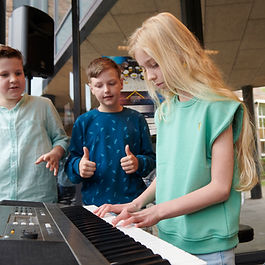
Music at Murmellius is a truly hands-on subject where you mainly get to work yourself! In the lessons, you sing together with your class, learn to play instruments such as bass guitar, guitar, ukulele, drums, and keyboard, and discover how fun it is to compose and produce your own music on the computer. Whether you already have experience or not: everyone can participate.
Moreover, by being actively involved with music, you develop important skills. You learn to work together in a group, listen carefully to each other, and plan an assignment over several weeks. Music is therefore not only creative, but also educational and incredibly fun.
Music
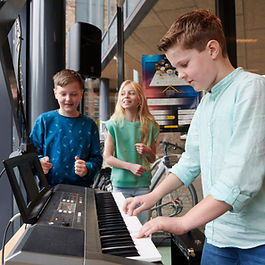
Music at Murmellius is a truly hands-on subject where you mainly get to work yourself! In the lessons, you sing together with your class, learn to play instruments such as bass guitar, guitar, ukulele, drums, and keyboard, and discover how fun it is to compose and produce your own music on the computer. Whether you already have experience or not: everyone can participate.
Moreover, by being actively involved with music, you develop important skills. You learn to work together in a group, listen carefully to each other, and plan an assignment over several weeks. Music is therefore not only creative, but also educational and incredibly fun.

People and society
In *Mens en Maatschappij* (People and Society), you learn many academic skills through interesting topics from society that you can use in the first year of secondary school in subjects such as geography and history. We work with varied workbooks, but also engage in conversation with each other. Discussing and debating are definitely part of it! This way, you learn not only facts, but also how to substantiate your opinion and listen to others respectfully. It often covers current topics, and we also regularly watch the youth news. One of the highlights of the intermezzo year in *Mens en Maatschappij* is the Island Game, where you get to manage your own island in a small group.

Philosophy
Een filosoof stelt de wilde vragen. De vragen die nog niet zijn gevangen met één enkel antwoord. Wat weet je absoluut zeker?
Hoe doet een goed mens? Héb je een lichaam of bén je een lichaam? Deze vragen raapt de filosoof op en durft er goed en lang over na te denken. Denk je veel en houd je van vreemde en moeilijke vragen? Dan is filosofie het vak voor jou. Zullen we antwoorden vinden? Dan kan niemand garanderen. Maar door te denken, te vragen en te redeneren worden we hoe dan ook wijzer.

Philosophy
Philosophy is all about wild questions. These are questions that are very important, but for which there is no fixed answer. Questions such as: what is happiness, really, what do we know for sure, do we have only a body or also a mind, or is it permissible for a poor man to steal a loaf of bread for his children? You won't find the answer to such questions on Wikipedia. So, together with other students, you will have to think about them yourself and see what smart women and men said about them in the past.

Physical education
Physical Education (PE) – or simply GYM, just like in primary school – is the subject where you learn through movement. At Intermezzo, you do more PE than in primary school; you have a double lesson (100 min) twice a week. PE lessons take place indoors in the gymnasium as well as outdoors on the beautiful sports fields of AMHC.
In PE class, we focus on learning through movement and important skills such as teamwork, perseverance, showing respect for one another, and dealing with winning and losing. During the lessons, you move in a fun and varied way, learn new skills, and discover where your talents lie. From team sports to individual challenges. Enjoyable movement is central to PE.

Physical education
Waarom zijn de gymlessen juist op een gymnasium zo belangrijk? “Mens sana in corpore sano”, ofwel: “een gezonde geest in een gezond lichaam”.
Wetenschappelijk onderzoek heeft namelijk aangetoond dat bewegen een positieve invloed heeft op leerprestaties! Daarnaast leer je tijdens de gymles ook allerlei andere dingen zoals samenwerken, doorzetten, elkaar helpen, organiseren en nog veel meer.
De kernwoorden voor het vak ‘lichamelijke opvoeding’ op het Murmellius Gymnasium zijn: bewegen, bewegen regelen, plezier, persoonlijke ontwikkeling, samen, veiligheid, gezondheid & oriëntatie.
Dit doen we op onze buitenvelden (30%) , in de verschillende gymzalen (60%) en andere beweeglocaties(10%). We starten het jaar van de zomer- tot de herfstvakantie op de buitenlocaties, na de herfstvakantie gaan we naar de binnen gymzalen. Vervolgens sluiten we het jaar af van de mei- tot de zomervakantie op de buitenlocaties.

Physics
Physics deals with all the forces at work in nature. For example, you learn why it feels like the wind is suddenly blowing much harder when you cycle very fast to school (because you left home too late again). You also learn why you aren't flung off the earth even though it rotates at about 1670 km/h! Physics is taught at our school starting from the second year.

Science
You take the Science subject for half a year. During this subject, we work on a number of themes and dive into the world of science. Together, we will learn how scientists solve problems in real life. The themes relate to biology, physics, and a bit of mathematics and chemistry. For example, we will conduct a real biological experiment, explore space, and study planet Earth. We also learn to think about facts and opinions, and where the two overlap.

Social studies
In Year 5, everyone takes Social Studies. You acquire a great deal of factual knowledge about the rule of law, democracy, and politics. How does the House of Representatives work? What does the government do? What are your rights and obligations? And why is the rule of law so important? But Social Studies is more than just knowledge. It is also about citizenship. You reflect on your own role in society and discuss current social issues. Following the news is a major part of this subject! You learn to look at the news critically. You learn how to properly substantiate your viewpoints and how to engage in respectful dialogue with others. Social Studies essentially forms the conclusion of the citizenship lessons that were already covered in other subjects in the lower years. Everything comes together: knowledge, skills, and your own opinion. After these lessons, you can exercise your right to vote with peace of mind!